

How Vision Works

The Path of Light Through the Eye
Light
Light reflected by objects enters the eye, passing successively through the cornea, pupil, and lens, and ultimately reaches the retina, where it is converted into an electrical signal.
The Cornea
The cornea is the first transparent structure to refract (bend) light. It acts as a natural lens, making an essential contribution to focusing light rays inside the eye.
The Iris
The iris, located around the pupil, functions like a diaphragm that controls the amount of light entering the eye. In bright light, the pupil contracts; in darkness, it dilates — this mechanism regulates not only exposure, but also the depth of the visual field.
The Lens
The lens, a flexible and transparent structure, changes shape to allow clear focusing of images at different distances — a process called accommodation.
The Retina
After it has been correctly directed and focused, light reaches the retina — a photosensitive tissue located at the back of the eye. It contains two main types of photoreceptor cells called cones and rods.
Cones
Cones, which are active in bright light, enable the perception of colors and fine detail.
Rods
Rods function in low light, providing peripheral and black-and-white vision that is useful for orientation in darkness.
Electrical Impulse
The light signal is transformed by the retina into an electrical impulse, which is transmitted through the optic nerve to the brain, where the image is interpreted.
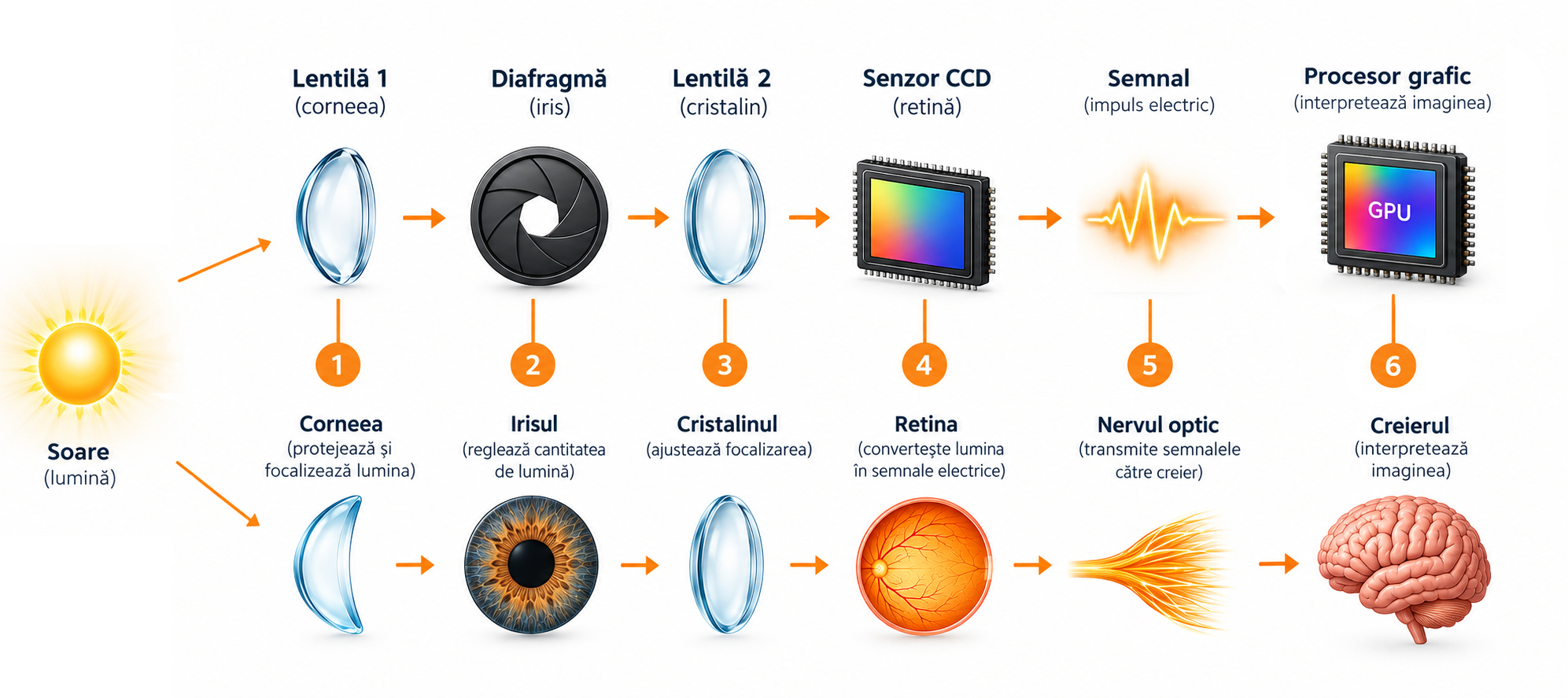
The Eye — a Natural Camera
The structure and function of the eye are remarkably similar to those of a digital camera. Each component of the eye has an equivalent in the camera mechanism:
- The cornea — functions as a fixed outer lens that begins the process of focusing light.
- The iris — acts as a diaphragm, controlling the amount of light entering the eye, just as a camera regulates exposure.
- The lens — is equivalent to a group of movable lenses that changes shape to focus the image clearly at different distances.
- The retina — plays the role of the digital sensor, capturing the image and transforming light into electrical signals.
- The optic nerve — is the transmission cable that sends the electrical signal to the brain.
- The brain — functions like a computer: it receives the signal, processes it, and constructs the consciously perceived image.