

Astigmatism: Causes, Symptoms, and Correction Options
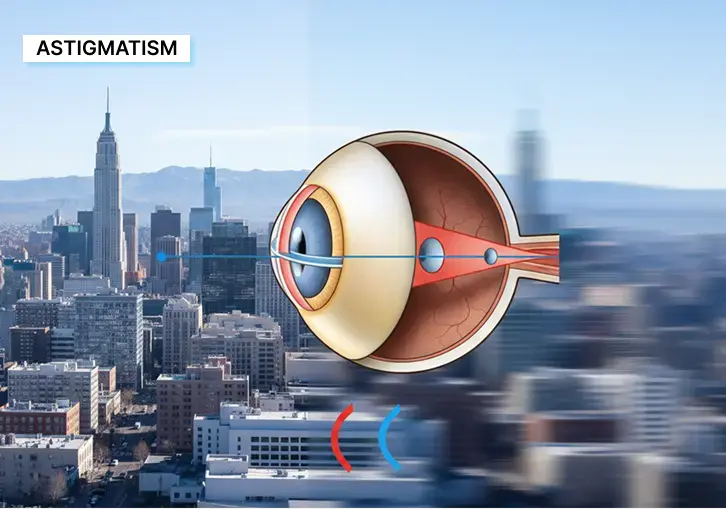
The main causes of astigmatism are structural and relate to the cornea’s imperfect curvature. Rather than being perfectly round, it has an irregular shape, like a rugby ball, which causes light to be focused incorrectly on the retina. As a result, specific symptoms occur, the most important being blurred or distorted vision at all distances, both near and far. Fortunately, effective correction methods are available, such as glasses with cylindrical lenses or toric contact lenses, which compensate for this refractive error and restore image clarity.
How does it work?
In a normal eye, light entering through the cornea is focused evenly on the retina, forming a clear image.
With astigmatism, the cornea’s irregular curvature causes light rays to be refracted unevenly—some are focused in front of the retina and others behind it.
👉 Imagine the cornea as having several axes running across it. If these axes have different curvatures, light no longer reaches a single point on the retina, but several points, creating a blurred image.
Symptoms of astigmatism:
- blurred or distorted vision (at distance and near)
- difficulty focusing visually
- frequent headaches
- eye fatigue, especially after prolonged reading or computer work
How is astigmatism corrected?
Astigmatism is corrected with:
- glasses with cylindrical lenses, which compensate for differences in curvature only along the affected axis
- toric contact lenses, specially designed to fit the unique shape of the eye
- refractive surgery (e.g., LASIK), in selected cases, to reshape the cornea
Conclusion:
Astigmatism is not a disease, but a common refractive error that is easy to diagnose and correct.
With suitable glasses or other personalised methods, vision can be clear and comfortable.
A comprehensive eye examination is essential to identify the exact type and degree of astigmatism and choose the appropriate correction.