

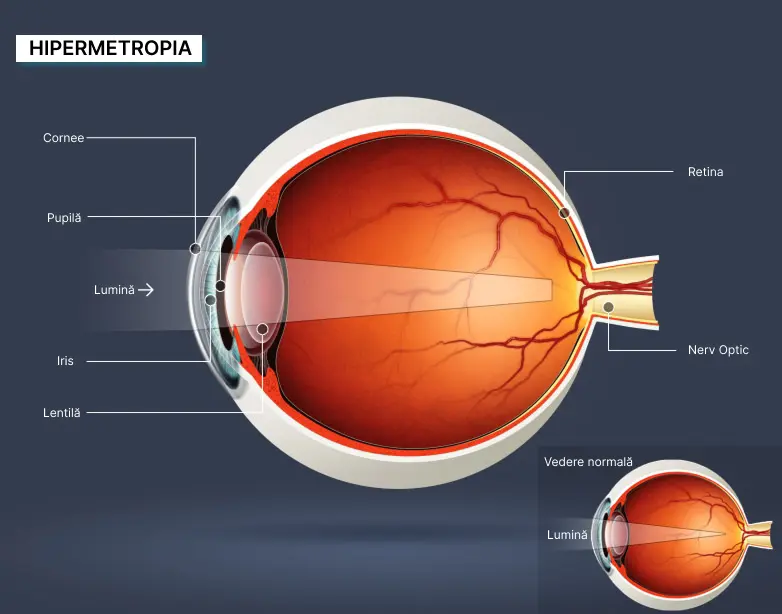
Hyperopia: Causes, Symptoms, and Correction
Causes of the Condition
Hyperopia is a refractive error in which light rays entering the eye are focused at an imaginary point behind the retina rather than directly on its surface. This focusing error generally has two main causes: either the eyeball is shorter than normal (axial hyperopia), or the cornea or lens has insufficient curvature, reducing its refractive power (refractive hyperopia). Although it is often an inherited condition, it can affect anyone at any age.
Symptoms and Signs
Unlike people with myopia, people with hyperopia may see distant objects relatively clearly but have difficulty with near vision. The constant effort the eye must make to compensate and focus correctly often leads to symptoms such as:
- Blurred vision, especially when reading, writing, or working at a computer.
- Frequent headaches or a feeling of pressure around the eyes.
- Eye strain (asthenopia) after activities that require near vision.
- A need to squint to see more clearly.
- In children, uncorrected hyperopia can lead to complications such as strabismus (crossed eyes) or amblyopia (“lazy eye”).
Correction and Treatment Methods
Correcting hyperopia is essential for clear vision and to eliminate discomfort. The most common method is wearing glasses or contact lenses with converging (convex) lenses, marked with a “+” sign, which help bring the image onto the retina. For a long-term solution, adult patients may opt for refractive surgery (for example, LASIK), which reshapes the cornea to permanently correct the refractive error. Whatever option is chosen, regular eye examinations are vital for monitoring the condition and adjusting the prescription.