What are they?
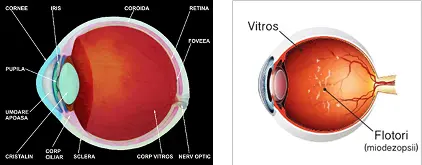
Floaters or “flying flies” (in medical terms myodesopsia) are translucent spots, lines, or specks that appear in the visual field and seem to “float” with eye movements; they may be warning signs.
They become more visible when you look at a light background (for example, a clear sky or a white sheet of paper). Although they can be bothersome, in many cases they are benign and common phenomena, especially after the age of 40–50.

Why do they occur?
Floaters are caused by changes in the vitreous body – a gel-like substance that fills much of the posterior segment of the eye and helps maintain the eye’s shape, as well as providing mechanical support to the retina. The vitreous is composed mainly of water (99%), but also contains hyaluronic acid and proteins such as collagen. It is located behind the lens but in front of the retina, so light must pass through the vitreous body to reach the retina. Consequently, for light not to be obstructed, the vitreous body should always be perfectly transparent.
With age, the vitreous liquefies and the collagen fibers inside it clump together, casting shadows on the retina.
Causes and contributing factors:
• Natural aging of the eye;
• Myopia;
• Eye trauma;
• Eye surgery;
• Intraocular inflammatory processes (uveitis).
Are they dangerous?
Most of the time, floaters are harmless and merely bothersome. However, they can also be a warning sign when they appear suddenly, in large numbers, or are accompanied by:
• flashes of light (sparks or visual “lightning”);
• loss of part of the visual field (like a black “curtain”);
• sudden blurred vision.
These may indicate a retinal detachment or a retinal tear – ophthalmic emergencies requiring immediate examination.
How are they managed?
• In benign, forms, no treatment is necessary; only monitoring and regular check-ups with an ophthalmologist are needed;
• In severe or persistent cases, options include:
- vitrectomy (surgery, rarely used for isolated floaters);
- laser vitreolysis (in certain selected cases).
Conclusion
The presence of floaters (flying flies) is usually a normal process related to aging. However, a sudden change—such as an increase in their number, association with flashes of light, or loss of the visual field—means that a serious problem may be present, making an emergency ophthalmic examination essential.